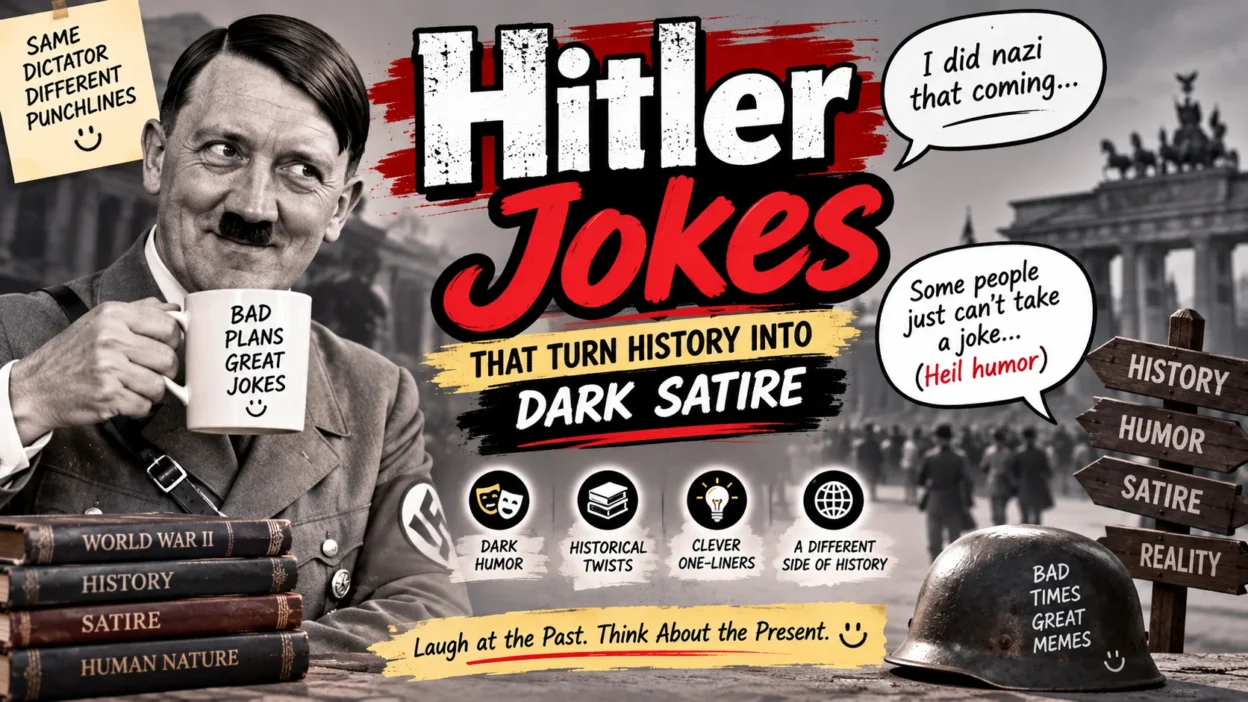
History is full of serious moments, but sometimes Hitler jokes can be used as historical satire when the target is the dictator himself rather than the people harmed by his regime. Adolf Hitler’s obsession with power, propaganda, grand plans, and eventual downfall provides material for critical humor without glorifying Nazism or making light of the Holocaust.
This collection uses historical jokes, dictator humor, World War II satire, Nazi Germany references, propaganda jokes, and dark historical humor to poke fun at authoritarianism and Hitler’s absurd self-image. The emphasis stays on criticizing dictatorship and exposing the ridiculousness behind the supposed grandeur.
What Are Hitler Jokes? A Quick Guide
Hitler jokes are jokes or satirical observations centered on Adolf Hitler, his dictatorship, propaganda, historical failures, and the absurdity of authoritarian ambition. Responsible historical satire targets the dictator, ideology, and abuse of power rather than victims of Nazi persecution.
Historical Hitler Jokes 📚😂
Historical satire can turn familiar facts into sharp observations. These jokes focus on Hitler’s public image, political ambition, and place in history.
- 📚 Hitler wanted to become unforgettable; history certainly delivered, just not the way he imagined.
- 😂 His career proves that terrible ideas can still have extremely serious consequences.
- 📚 History class has a simple rule: never confuse infamy with greatness.
- 😂 Hitler aimed for a thousand-year legacy and received a permanent warning label instead.
- 📚 His greatest historical achievement was becoming an example of what leadership should never become.
- 😂 The history books remembered him, but definitely did not give him the review he wanted.
- 📚 Hitler wanted admiration; history gave him condemnation.
- 😂 His political résumé would have been rejected by the ethics department.
- 📚 Some historical figures inspire people; Hitler mostly inspires warnings.
- 😂 He wanted monuments to himself and ended up with documentaries about his mistakes.
- 📚 His name became famous for all the wrong reasons.
- 😂 History has a brutal editor: arrogance rarely gets a happy ending.
- 📚 Hitler’s legacy is less “legendary leader” and more “never repeat this.”
- 😂 He chased historical greatness and accidentally became a case study in catastrophe.
- 📚 The history textbook had plenty of pages for him, none of them flattering.
Hitler Dictator Jokes 👔😂
Dictatorship provides plenty of material for critical satire. These jokes focus on authoritarian behavior, ego, and the ridiculousness of absolute power.
- 👔 Absolute power apparently comes with absolutely terrible decision-making.
- 😂 Hitler wanted everyone following orders, but history eventually gave him the final rejection.
- 👔 Dictators love control until reality refuses to cooperate.
- 😂 Being surrounded by yes-men probably makes bad ideas sound brilliant.
- 👔 The dictator’s favorite phrase was apparently “my plan,” even when the plan was terrible.
- 😂 Leadership without accountability is basically confidence with a dangerous upgrade.
- 👔 Hitler treated disagreement like a personal software bug.
- 😂 A dictatorship is the only workplace where questioning management can become a historical event.
- 👔 His management style had one major flaw: reality was not an employee.
- 😂 Hitler wanted total control but could not control how history remembered him.
- 👔 Dictators often demand loyalty because good arguments are harder to find.
- 😂 The ego was enormous; the historical judgment was considerably less generous.
- 👔 Power can create obedience, but it cannot manufacture wisdom.
- 😂 Hitler’s leadership style needed fewer speeches and considerably more self-reflection.
- 👔 Absolute authority apparently forgot to install an “Are you sure?” button.
Hitler and Propaganda Jokes 📢😂
Propaganda played a major role in Nazi Germany. These jokes criticize manipulation, political messaging, and manufactured public image.
- 📢 Propaganda promises perfection; reality usually keeps the receipts.
- 😂 Hitler’s publicity department had one job: make terrible ideas sound impressive.
- 📢 Propaganda can polish a message, but it cannot permanently polish history.
- 😂 The campaign slogan should have included a giant historical warning sign.
- 📢 A dramatic speech cannot turn a disastrous ideology into a good idea.
- 😂 Hitler mastered theatrical presentation and completely failed the morality test.
- 📢 Propaganda sells certainty even when the facts are filing a complaint.
- 😂 The louder the speech, the more important critical thinking becomes.
- 📢 Political theater works best when the audience forgets to check the script.
- 😂 History eventually fact-checks every dictator.
- 📢 Propaganda loves repetition because reality is harder to control.
- 😂 The biggest special effect was convincing people that arrogance counted as wisdom.
- 📢 A microphone can amplify a voice, not improve an argument.
- 😂 Propaganda had plenty of volume and remarkably little moral sense.
- 📢 The strongest antidote to propaganda is remembering to question the message.
Hitler World War II Jokes 🌍😂
World War II was a catastrophic historical event, so humor here should avoid trivializing suffering. These jokes instead target Hitler’s strategic arrogance and the absurdity of his decisions.
- 🌍 Hitler’s military planning had confidence levels that reality could not support.
- 😂 Apparently “reconsider the strategy” was missing from the meeting agenda.
- 🌍 Invading more territory is not automatically a substitute for having a sensible plan.
- 😂 His strategic confidence aged considerably worse than the military maps.
- 🌍 History’s harshest military lesson: ambition does not defeat logistics.
- 😂 The map looked impressive until geography started participating.
- 🌍 Hitler kept expanding the problem instead of solving it.
- 😂 His strategy meetings needed one person assigned exclusively to asking, “But should we?”
- 🌍 Military history remembers bold moves, but it also remembers disastrous ones.
- 😂 Overconfidence is a terrible co-pilot.
- 🌍 Hitler’s plans had ambition, complexity, and one unfortunate ingredient: reality.
- 😂 A bigger map does not necessarily mean a better strategy.
- 🌍 History proved that resources matter more than dramatic speeches.
- 😂 Strategic optimism eventually met logistical pessimism.
- 🌍 The lesson was simple: geography always gets a vote.
Hitler Failed Ambition Jokes 📖😂
Hitler imagined himself as a major historical visionary, but his ambitions ended in catastrophic failure. These jokes target that self-important image.
- 😂 Hitler wanted to reshape history; history reshaped his reputation instead.
- 📖 He aimed for greatness and became a textbook warning.
- 😂 The ambition was enormous; the final review was disastrous.
- 📖 Some people leave inspirational legacies; others leave cautionary chapters.
- 😂 Hitler’s biggest problem was apparently believing his own propaganda.
- 📖 The dream of permanent power met the reality of historical consequences.
- 😂 He wanted history to applaud and got the opposite reaction.
- 📖 His legacy proves that being remembered is not the same as being admired.
- 😂 The ego ordered a standing ovation; history ordered a correction.
- 📖 Grand ambition without morality is just a bigger disaster.
- 😂 Hitler wanted to control the narrative and lost that battle permanently.
- 📖 The history book gave him plenty of space but very little praise.
- 😂 His reputation definitely survived; unfortunately for him, it survived as a warning.
- 📖 The ultimate historical plot twist was becoming an example of failure.
- 😂 A giant ego does not guarantee a great ending.
Hitler Dark Humor Without Glorification 🖤😂
Dark historical humor requires careful targeting. These jokes mock authoritarian arrogance and absurdity without joking about genocide, victims, or persecution.
- 🖤 The darkest joke about dictatorship is that one person can take bad ideas far too seriously.
- 😂 Hitler’s ego could have used a reality check, preferably before the history books.
- 🖤 Dictatorship: when one person’s confidence becomes everybody else’s problem.
- 😂 The irony of demanding total control is discovering history controls the final narrative.
- 🖤 Hitler wanted fear to define his legacy; condemnation became the louder voice.
- 😂 A dictator’s greatest enemy may be a history textbook with footnotes.
- 🖤 Authoritarianism has one recurring flaw: leaders are still capable of terrible decisions.
- 😂 Hitler’s confidence needed moderation more than his speeches needed amplification.
- 🖤 The historical punchline is that power never made him morally impressive.
- 😂 The ego was enormous, but the historical verdict was straightforward.
- 🖤 Dictators can control newspapers; they cannot permanently control historical judgment.
- 😂 The propaganda machine had horsepower, but history had brakes.
- 🖤 Dark history becomes meaningful when satire exposes the danger behind the absurdity.
- 😂 Hitler wanted unquestioning followers; history recommends critical thinking instead.
- 🖤 The most important punchline is that authoritarianism should never become normal.
Hitler Ego Jokes 😏😂
One of the safest targets for historical satire is Hitler’s enormous ego and self-important public persona.
- 😏 Hitler’s ego entered the room before he did.
- 😂 Confidence is useful; unlimited confidence without wisdom is historical material.
- 😏 His mirror probably needed its own security detail.
- 😂 Hitler apparently mistook being certain for being correct.
- 😏 The ego had executive authority and absolutely no quality-control department.
- 😂 His confidence never seemed to receive updates from reality.
- 😏 If arrogance were an Olympic sport, the podium might have needed extra space.
- 😂 Hitler had no shortage of confidence and a severe shortage of humility.
- 😏 The ego wanted applause; history handed it criticism.
- 😂 Confidence without conscience is just noise wearing a uniform.
- 😏 His self-image needed a much smaller frame.
- 😂 The biggest speech in the room was sometimes happening inside his own head.
- 😏 Ego said “legend”; history said “warning.”
- 😂 His confidence was undefeated until reality entered the competition.
- 😏 Historical humility would have been an excellent addition to the résumé.
Hitler History Class Jokes 🎓😂
History lessons often introduce students to difficult subjects. These classroom jokes use textbooks, exams, timelines, and historical facts as the source of humor.
- 🎓 History teachers have one rule: learn the lesson, not the ideology.
- 😂 The textbook contains plenty of Hitler facts and absolutely no fan mail.
- 🎓 A history exam is where dates suddenly become everyone’s worst enemy.
- 😂 Hitler’s chapter is long because terrible decisions can create enormous consequences.
- 🎓 Students learn quickly that historical fame can be extremely negative.
- 😂 The test question “Why was this a bad idea?” practically answers itself.
- 🎓 History class proves that being famous and being admirable are unrelated.
- 😂 The textbook’s warning signs are practically highlighted in bold.
- 🎓 One chapter can teach more about authoritarianism than a hundred motivational speeches.
- 😂 The timeline gets complicated when one dictator keeps making catastrophic decisions.
- 🎓 History homework: remember the facts and reject the propaganda.
- 😂 The teacher says “important historical figure,” and everyone checks whether “important” means “good.”
- 🎓 Historical analysis works better than hero worship.
- 😂 The exam asks for causes, effects, and several reasons nobody should repeat them.
- 🎓 History class: where the past keeps sending extremely obvious warnings.
Hitler Leadership Jokes 🤦😂
Leadership satire can highlight the difference between authority and genuine leadership. These jokes focus on poor judgment, ego, and authoritarian management.
- 🤦 Authority can force obedience, but it cannot force good leadership.
- 😂 Hitler’s leadership model came with an enormous warning label.
- 🤦 A leader who never accepts criticism eventually receives it from history.
- 😂 The management strategy was simple: disagree at your own historical risk.
- 🤦 Good leaders listen; dictators mostly issue instructions.
- 😂 Hitler apparently skipped the chapter on constructive feedback.
- 🤦 Leadership without accountability is a recipe nobody should cook.
- 😂 His strategy meetings could have benefited from one independent thinker.
- 🤦 A room full of yes-men is not exactly a brainstorming session.
- 😂 The biggest leadership lesson was what not to copy.
- 🤦 Authority is not competence wearing a fancy uniform.
- 😂 A dictator can silence criticism without making the criticism wrong.
- 🤦 The best leadership tool is judgment, not intimidation.
- 😂 History eventually became the performance review nobody could ignore.
- 🤦 The final lesson: power should never replace wisdom.
Hitler Speech Jokes 🎤😂
Hitler was known for highly theatrical public speaking. These jokes target the spectacle, repetition, and political theater rather than victims.
- 🎤 The microphone amplified the speech, unfortunately not the wisdom.
- 😂 Volume can make a room quiet without making an argument convincing.
- 🎤 Every dramatic speech still needs a good idea underneath it.
- 😂 Hitler’s speeches had plenty of energy and a severe shortage of moral direction.
- 🎤 Political theater is still theater when the curtain falls.
- 😂 The microphone did its job; history did the fact-checking.
- 🎤 A loud speech cannot turn an evil ideology into a respectable one.
- 😂 The dramatic delivery deserved less applause and more scrutiny.
- 🎤 Public speaking skill does not equal leadership quality.
- 😂 A powerful voice can still deliver a terrible message.
- 🎤 History remembers what was said and what happened afterward.
- 😂 The microphone was innocent; the message was the problem.
- 🎤 Charisma becomes dangerous when nobody questions where it is going.
- 😂 The volume knob had more restraint than the political strategy.
- 🎤 The best historical response to propaganda is critical thinking.
Hitler Name and Reputation Jokes 📚🖤
Names can become powerful historical symbols. These jokes focus on reputation and the difference between fame and honor.
- 📚 Hitler’s name became famous, but fame definitely did not become praise.
- 😂 Some names inspire smiles; this one mostly inspires history lessons.
- 📚 His name appears in textbooks as a warning rather than a recommendation.
- 😂 The name survived history, but the reputation did not survive judgment.
- 📚 Being remembered forever sounds impressive until the context arrives.
- 😂 Hitler achieved permanent name recognition without earning permanent admiration.
- 📚 His name became shorthand for authoritarian evil.
- 😂 The historical brand awareness was unfortunately extremely negative.
- 📚 A name can survive centuries without carrying anything worth celebrating.
- 😂 Hitler’s reputation got the worst possible five-star review: “Never repeat.”
- 📚 History remembers names according to actions, not ambitions.
- 😂 His name is proof that immortality and respect are completely different things.
- 📚 Some legacies are monuments; others are warnings.
- 😂 Hitler definitely left a legacy—just not one anyone should want.
- 📚 History gave the name permanence and the verdict was condemnation.
Hitler Irony Jokes 🔄😂
Irony can expose contradictions in authoritarian thinking. These jokes focus on the gap between Hitler’s ambitions and the way history ultimately judged them.
- 🔄 He wanted control over history but could not control historical judgment.
- 😂 He wanted admiration and became an international symbol of warning.
- 🔄 He demanded obedience while making decisions that deserved serious questioning.
- 😂 The plan was supposed to create glory; the result created a cautionary tale.
- 🔄 He wanted permanence and received historical infamy instead.
- 😂 The propaganda promised strength while history documented catastrophic failure.
- 🔄 The bigger the ambition became, the bigger the consequences became.
- 😂 He wanted to write history and ended up becoming one of its darkest lessons.
- 🔄 Absolute confidence met absolute reality.
- 😂 The irony was stronger than the speeches.
- 🔄 He wanted a perfect image; history kept adding footnotes.
- 😂 The final historical editor had no interest in flattering language.
- 🔄 The regime demanded certainty while reality remained stubbornly independent.
- 😂 The greatest plot twist was history refusing to follow the script.
- 🔄 Power attempted to control the narrative; facts outlasted the propaganda.
Hitler Meme-Style Jokes 😂📱
Modern meme-style humor can criticize historical figures without glorifying extremist ideology. These short jokes use internet-style phrasing.
- 📱 Hitler: “I have a plan.” History: “That sounds concerning.”
- 😂 History textbook: “Here comes the warning section.”
- 📱 Reality: “Please reconsider.” Hitler: “No.” History: “Noted.”
- 😂 Hitler’s confidence had unlimited battery but terrible navigation.
- 📱 Group project feedback: “Maybe don’t start a dictatorship.”
- 😂 History’s comment section would have needed unlimited moderation.
- 📱 Hitler: “Trust the plan.” Geography: “Absolutely not.”
- 😂 Historical strategy review: ambitious, disastrous, never recommend.
- 📱 Ego: 100%. Wisdom: connection lost.
- 😂 The history textbook has entered the chat with several warnings.
- 📱 Propaganda: “Everything is under control.” Reality: “Interesting.”
- 😂 Hitler’s plan needed an editor, a critic, and probably a completely different author.
- 📱 History: “Remember this.” Students: “Unfortunately, yes.”
- 😂 The biggest historical plot twist was reality refusing to cooperate.
- 📱 Dictator mode: activated. Good judgment: apparently unavailable.
Hitler Jokes About Historical Lessons 🧠📚
Satire becomes more meaningful when it reinforces the lessons history is meant to teach. These jokes target authoritarianism while keeping the educational message intact.
- 🧠 History’s funniest lesson is sometimes also its most serious warning.
- 📚 Power without accountability can turn arrogance into catastrophe.
- 🧠 Critical thinking is the ultimate antidote to political propaganda.
- 📚 A charismatic speaker can still promote terrible ideas.
- 🧠 History repeatedly proves that confidence should never replace evidence.
- 📚 Dictatorships demonstrate why institutions and accountability matter.
- 🧠 The past becomes useful when its mistakes are remembered honestly.
- 📚 Propaganda becomes weaker when people learn to question sources.
- 🧠 Good history asks what happened, why it happened, and what can prevent repetition.
- 📚 The strongest response to authoritarianism is informed awareness.
- 🧠 A historical joke works best when the punchline exposes the danger.
- 📚 Hitler’s history is not a blueprint; it is a warning.
- 🧠 The past cannot be changed, but its lessons can influence the future.
- 📚 Historical satire can make difficult lessons easier to remember.
- 🧠 The smartest punchline is refusing to repeat the mistake.
Short Hitler Jokes for History Posts 📱📚
Short-form humor works well for educational social media when the context remains clear. These lines are suitable for history-themed posts and discussions.
- 📚 History remembered the dictator; admiration was not included.
- 😂 Ego wrote the script; reality changed the ending.
- 📚 Infamy is not the same thing as greatness.
- 😂 History’s review: absolutely not recommended.
- 📚 Propaganda talks; facts remain.
- 😂 Big ego, terrible historical rating.
- 📚 Power without wisdom creates warnings.
- 😂 History has a permanent fact-check button.
- 📚 Dictators fear criticism; history preserves it.
- 😂 The textbook remembers everything.
- 📚 Fame without honor is just infamy.
- 😂 Reality always gets the final edit.
- 📚 History never forgets consequences.
- 😂 The ego lost to the footnotes.
- 📚 Critical thinking beats political theater.
FAQs About Hitler Jokes 🤔📚
Are Hitler jokes appropriate?
It depends on the target and context. Historical satire that mocks Hitler, dictatorship, propaganda, and authoritarianism can be very different from jokes that mock Holocaust victims or persecuted groups.
What makes a Hitler joke respectful?
A responsible joke targets the dictator, his ideology, political arrogance, propaganda, strategic failures, or authoritarianism rather than victims of Nazi persecution. This keeps the humor critical rather than hateful.
Can Hitler be used in dark humor?
Yes, historical dark humor can address Hitler when the joke is clearly critical of him or the Nazi regime. It should not trivialize genocide, antisemitism, persecution, or the suffering of victims.
Why is Hitler often used in historical satire?
Hitler is one of history’s most recognizable examples of dictatorship, propaganda, political extremism, and catastrophic leadership. That makes his public image and historical failures common subjects for critical satire.
Can Hitler jokes be educational?
They can be when the humor reinforces historical understanding. Satire about propaganda, authoritarianism, military overconfidence, and political manipulation can encourage readers to think critically about history.
What should Hitler jokes avoid?
They should avoid celebrating Nazism, promoting antisemitism, mocking Holocaust victims, or making light of mass persecution and genocide. Satire is strongest when the dictator and destructive ideology are the target.
What are good alternatives to offensive historical jokes?
Historical satire, dictator jokes, propaganda jokes, World War II history humor, political absurdity, history-class jokes, and authoritarianism jokes can provide dark humor while maintaining a critical perspective.
Why does historical satire matter?
Historical satire can expose contradictions and arrogance while making difficult lessons memorable. When used responsibly, humor can encourage people to question propaganda and recognize the dangers of unchecked power.
Conclusion 🖤📚
The safest and most meaningful approach to Hitler jokes is to make Hitler himself, his dictatorship, propaganda, arrogance, failed ambitions, and authoritarian ideology the target. Humor does not need to mock victims or minimize historical suffering to be dark, sharp, or entertaining.
These jokes combine historical satire, dictator humor, World War II references, propaganda jokes, history-class humor, and critical political comedy to turn familiar historical themes into memorable observations. The result is humor that punches upward at power rather than downward at people who suffered under it.
History is already full of absurd contradictions. Sometimes the strongest joke is simply exposing how dangerous unchecked ego and absolute power can become.
The past wrote the warning; satire just adds the punchline. 🖤📚

Caleb Walker is a passionate humor writer and pun enthusiast who loves creating clever jokes, witty punchlines, and entertaining content for readers around the world. With a creative approach to comedy, Caleb shares fun-filled articles designed to spread laughter, smiles, and positive vibes every day through Punnect.